How to choose
Choosing a food processor size that earns its counter
Bowl capacity, the lower liquid line, the footprint and the parts list: the four numbers that decide whether a food processor gets used or stored.
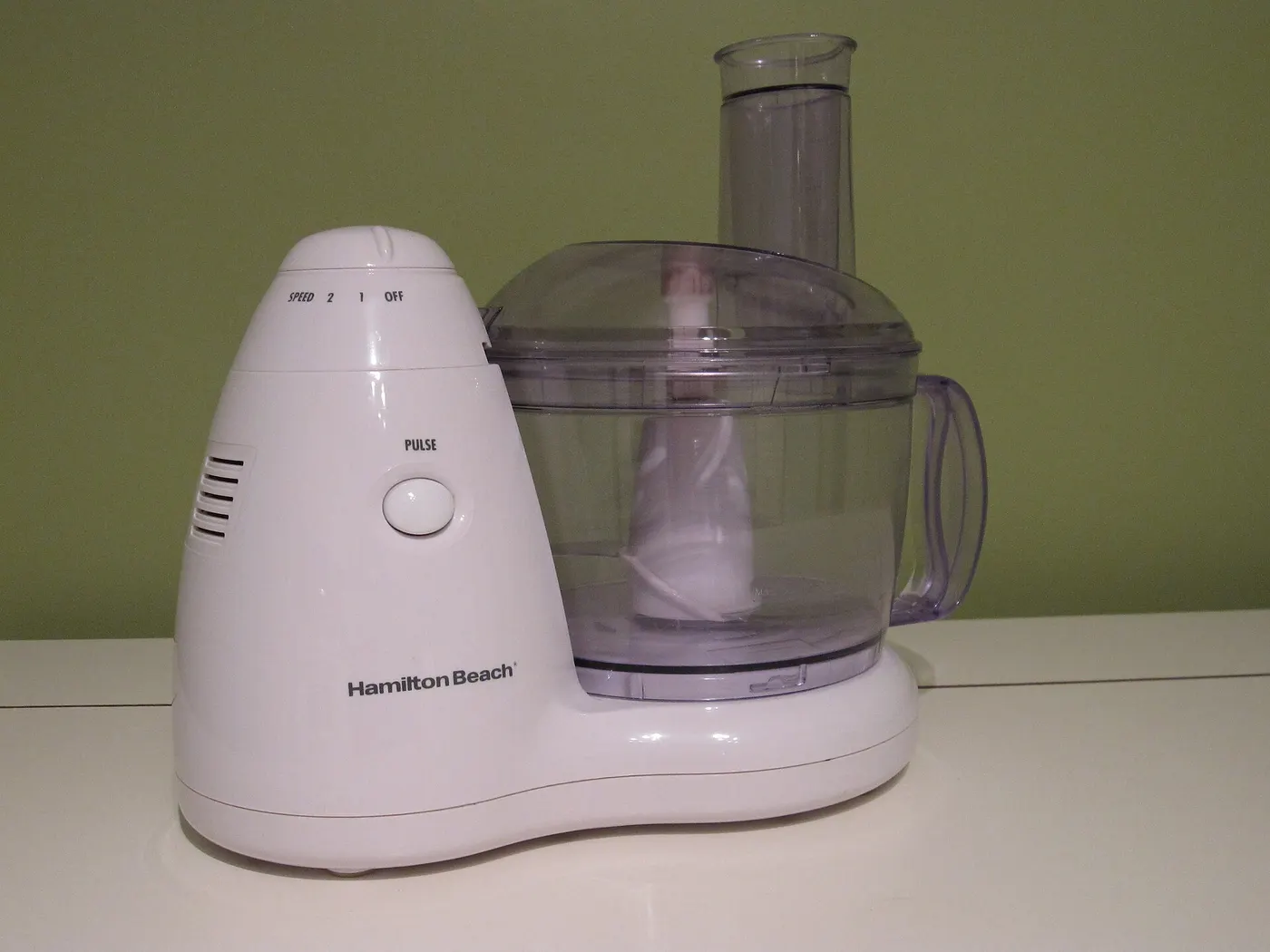
A food processor is bought on bowl capacity and abandoned on counter space. The two are connected: the bowl that holds the big batch is attached to a base that is too tall to live under a wall cabinet, and an appliance in a cupboard is an appliance that stops being used.
This guide works through capacity, the liquid line that is always lower than the headline number, the footprint and the parts list. Prices below are example figures, said so in the same sentence, because this site has no price feed and quotes no seller.
The nominal bowl size is not the usable one
Every work bowl carries two limits and the box prints only one. The nominal capacity is what the bowl holds filled to the brim with dry ingredients. The liquid line is a separate, lower mark moulded or printed on the side of the bowl, and it exists because a spinning blade throws liquid up the wall and out past the lid seal.
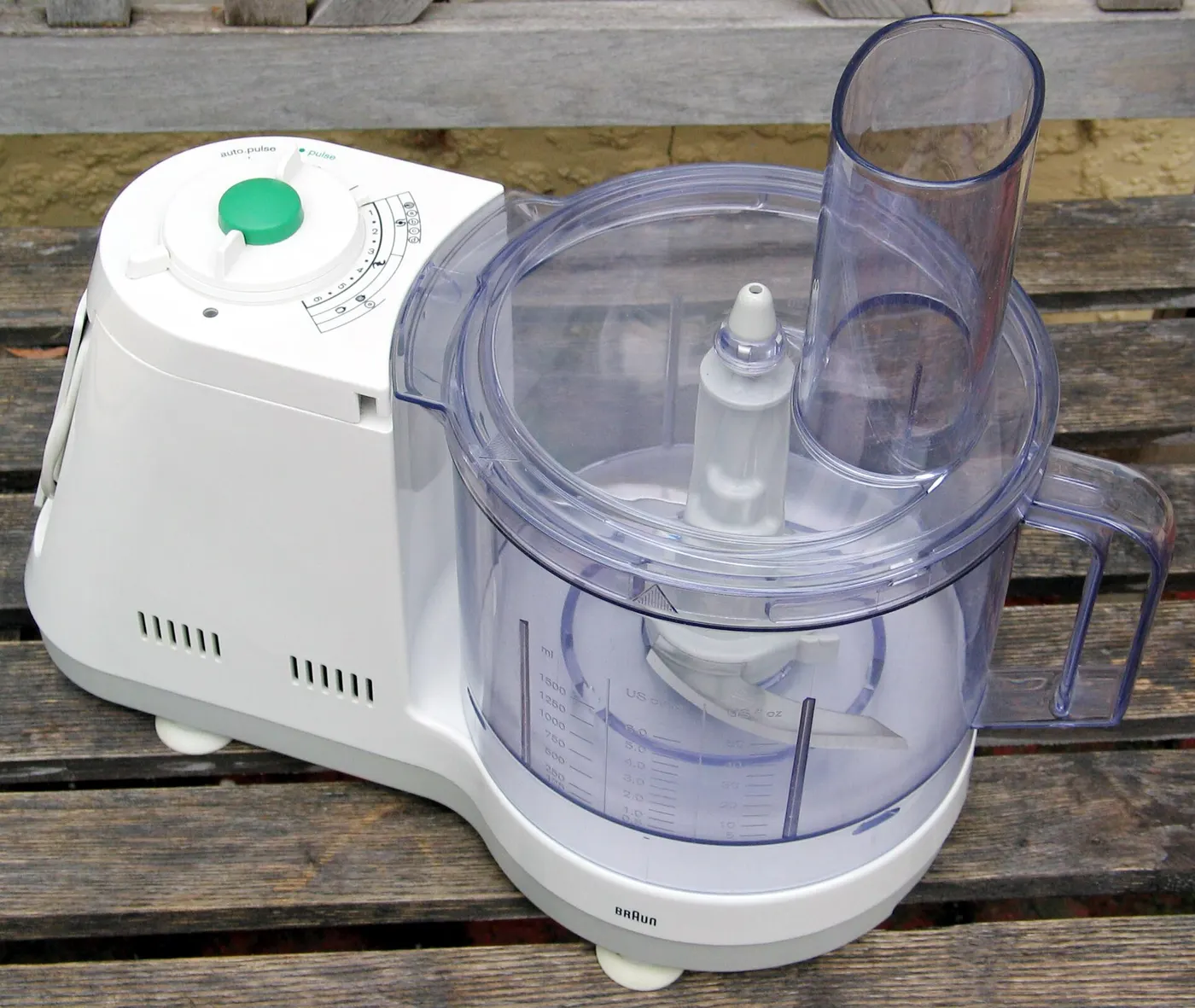
Look at the bowl rather than the box. The Braun bowls in the photographs below are graduated on the side in millilitres up to 1,500, with separate US cup and US fluid ounce scales beside them, which is exactly the mark you should be reading when you decide whether a soup batch fits.
The practical rule that follows is to size the machine on the liquid line for anything wet and on the nominal capacity only for dry work like pastry, breadcrumbs and slicing. A household that mostly chops onions and grates cheese can buy small; a household that purées soup needs the next size up for the same meal.
| Household | Typical batch | Bowl size that fits | Example price band |
|---|---|---|---|
| 1 to 2 people | Chopping, grating, small doughs | 3 to 7 cup mini or compact | $40 to $90 |
| 2 to 4 people | Everything above plus soup, hummus, pesto | 9 to 11 cup | $100 to $200 |
| 5 or more people, or batch cooking | Pastry, large doughs, double soup batches | 12 to 16 cup | $200 to $400 |
| Occasional use, 2 or 3 times a month | Chopping only | A hand-cranked chopper | $20 to $45 |
Price bands are examples showing the order of magnitude, not quotations from any seller. Bowl sizes are the usual nominal capacities; check the liquid line on the bowl itself before assuming a soup batch fits.
Footprint and height decide whether it stays out
Measure the clearance under your wall cabinets before you measure anything else, because that number rules out machines regardless of how good they are. A full-size processor with the feed tube pusher in place is taller than the base alone, and the tube has to come out vertically to load it.
The depth matters as much. A standard US kitchen counter is 24 inches deep with the back 2 or 3 inches lost to a backsplash or an outlet strip, and a processor with a side-mounted motor housing is wider than it is deep, which is the shape that fits best against a wall.
There is a usable test. If the machine cannot be used where it is stored, it will be stored and not used. A processor that lives on the counter gets used 3 times a week; one that lives in a low cupboard and weighs 12 pounds gets used twice a month, and the per-use arithmetic in our running-cost guide shows exactly what that does to the cost of owning it.
- Measure the clearance from counter to wall cabinet and write it down before you shop
- Add the height of the feed tube pusher to the quoted machine height, not just the base
- Check the usable counter depth after the backsplash and any outlet strip
- Decide where it will live before you buy, and buy only what fits there
- Weigh the machine if it will be lifted in and out: anything over about 12 pounds will not be
There is no efficiency label to compare, so compare something else
ENERGY STAR certifies products across heating and cooling, appliances, water heaters, lighting, building products, office equipment and electronics. In the appliances category it covers clothes dryers, clothes washers, dehumidifiers, dishwashers, electric cooking products, freezers, refrigerators and air cleaners. There is no category for food processors, blenders, toasters or kettles.
That means no label exists to rank countertop prep machines on energy, and it also means the energy question is not worth much of your attention. A machine that runs for 3 minutes a day costs a couple of dollars a year to operate, which our running-cost guide works out line by line.
What to compare instead is the parts list. A machine whose bowl, lid, blade and pusher are sold individually can be kept for a decade; one where a cracked bowl means a new machine cannot. That is a question you can answer on the manufacturer's own support pages before you buy, and it is worth more than any specification on the box.
| Specification on the box | How useful | Better question |
|---|---|---|
| Motor wattage | Low | Does it stall on stiff dough, and is there a thermal cutout |
| Nominal bowl capacity | Partly | Where is the liquid line marked on the bowl |
| Number of discs and blades | Low | Which blades do you own already, and do these store safely |
| Speed settings | Low | Is there a pulse that stops cleanly |
| Warranty length | Useful | Are bowls, lids and blades sold separately after it expires |
ENERGY STAR has no certification category for food processors or other small countertop prep appliances, so there is no efficiency figure to compare between models.
Motor, blade and the bowl lock
Wattage is a weak proxy for capability because a food processor is limited by torque at low speed rather than by peak power. The useful question is whether the machine stalls on a stiff dough and whether it has a thermal cutout that protects the motor when it does, which is a thing a manual says and a box does not.
The bowl lock is the component that fails on cheap machines, and it is a safety interlock rather than a convenience. The bowl has to be seated and the lid has to be latched before the motor will run, and the lug that carries that load is a small piece of plastic doing a job the whole machine depends on.
The blade is the easy part. An S-blade that sits low in the bowl and clears the base cleanly does most of the work; slicing and shredding discs are extras that get used less than people expect. Buy the machine for its bowl, its lock and its parts list, and treat the disc set as a bonus rather than a reason.
When not to buy one at all
A hand-cranked chopper does the single job most people buy a processor for, chopping onions and herbs, and it does it with no cord, no motor and a bowl that goes straight into the sink. At an example $20 to $45 it costs less than a tenth of a large processor and it stores in a drawer.
The honest threshold is frequency. At 3 uses a week an electric machine earns its counter space and its price falls to a few cents a use, as our running-cost guide shows. At 2 or 3 times a month, the same machine is costing ten times as much per use and taking up the counter the rest of the time.
Count your actual uses over a month before buying anything. A household that chopped onions 6 times and made soup once does not need a 14-cup machine; it needs a chopper and a stick blender, which together cost less than a third of one and both fit in a drawer.
| Uses per month | Jobs | Tool | Example price |
|---|---|---|---|
| 2 to 4 times | Chopping onions and herbs | Hand-cranked chopper | $20 to $45 |
| 4 to 8 times | Chopping plus puréeing soup in the pan | Chopper plus a stick blender | $55 to $110 together |
| 8 to 12 times | The above plus grating and slicing | 9 to 11 cup processor | $100 to $200 |
| 12 times or more | All of it plus pastry and doughs | 12 to 16 cup processor | $200 to $400 |
Frequencies are decision thresholds rather than measurements. Count your own uses for one month before choosing a row; the cost-per-serving calculator on this site will turn that count into a cost per use.
Before you buy
- Count your actual prep sessions over one month before choosing a size
- Measure the clearance from counter to wall cabinet and the usable counter depth
- Add the feed tube pusher height to the quoted machine height
- Find the liquid line on the bowl in the shop or in the manual, not on the box
- Open the manufacturer support pages and confirm bowls, lids and blades are sold separately
- Check the manual for a thermal cutout before trusting the machine with stiff dough
- Decide where it will live, and buy only what fits there
Questions readers ask
- How many cups do I actually need?
- Size for the batch you make most often rather than the largest you can imagine. A 9 to 11 cup bowl covers soup, hummus and pastry for 2 to 4 people, and the liquid line on the bowl, not the nominal capacity, is the figure that decides whether a wet batch fits. Dry work can use the full nominal capacity.
- Does a higher wattage mean a better machine?
- Not reliably. A processor is limited by torque at low speed rather than by peak power, so a higher number on the box does not tell you whether the machine stalls on stiff dough. Look instead for a thermal cutout in the manual and for a bowl lock that feels solid, which is where cheap machines give way.
- Is there an energy rating to compare?
- No. ENERGY STAR certifies dishwashers, refrigerators, freezers, clothes washers and dryers, dehumidifiers, air cleaners and electric cooking products, and has no category for food processors or other small countertop prep appliances. Running cost is small anyway at a few dollars a year; our running-cost guide works it out.
- Can a blender do the same job?
- For wet work, often yes, and a stick blender purées soup in the pan with nothing to wash but the shaft. For dry work, no: a blender cannot slice, grate or make pastry, and it stalls on anything that does not flow. The pairing that covers most households is a chopper plus a stick blender, at an example $55 to $110 together.
- What should I check before buying?
- Clearance under the wall cabinets including the feed tube pusher, the liquid line on the bowl, and whether bowls, lids and blades are sold separately after the warranty expires. Those three decide whether the machine fits, whether it holds your batch, and whether a cracked bowl ends it.
Sources
Some links on this site can earn us a commission. That does not change which product a guide recommends, and it adds nothing to your price. Advertising is not enabled on this site yet. When it is, ads will be labelled and kept visually separate from the guides.